
The AI Paradox.Love it, hate it, it’s here.
Three people spend three days in a shed on Cape Cod, asking what AI does to small business owners, to the people they employ, and to the graduates who cannot find work.
So who keeps their job?
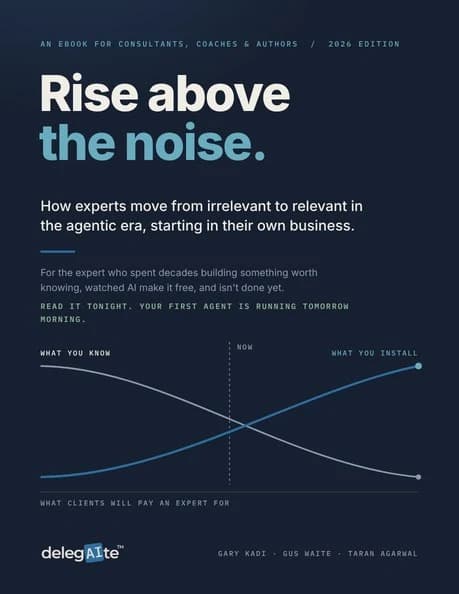
Watched the film? Start in your own business.
How experts move from irrelevant to relevant in the agentic era, starting in their own business. Leave your name and email and the download opens right here.
Three days. One shed. One question.
Gus Waite lost a twenty-year career when private equity cut costs. Gary Kadi sold his company and walked away from work. Taran Agarwal is young enough to have started in AI the moment ChatGPT came out. Gus put the three of them in a shed on Cape Cod for three days, with no agenda, to see what they could build.
Gus asks Gary a question that stops him in his tracks: what do you love to do?
The numbers work. That is the problem.
Gary draws the company he would have built ten years ago, role by role. The payroll comes to $700,000. Taran redraws it with agents doing the repetitive work and lands near $300,000.
Then comes the question: how would you feel if you had to fire twelve of your employees? The answer on camera is “I couldn’t do it.” The rest of the film looks for an answer that does not start with a layoff.
The people on camera.
- Gary Kadi
- Built a company, sold it, and stepped away from work. He calls himself a strategic architect and integrator for small businesses.
- Gus Waite
- Twenty years in real estate as a managing broker, laid off after private equity cut costs. He rebuilt his working life around AI on Cape Cod.
- Taran Agarwal
- Studied at New York University and started building with AI the moment ChatGPT came out. He automates the work owners hate doing.
- Mariya Di Luzio
- Left accounting and financial analysis after eight years, then worked in jewelry and ran her own vegan dessert company, doing its marketing herself. Getting sick showed her how hard it is for functional medicine to be found. When AI arrived, it became the way to help that field grow.
- Two graduates
- One in Berlin with a master’s degree, facing a job market that is harder to enter. One with a master’s in data science, working at a fried chicken counter.
“Somebody asked me one time, what did it cost me? And it was everything.”
“I got a very clear intuition that I should just stop, sit still, get quiet, and allow things to unfold.”
“Any pain point in your business that you hate doing, that is manual and repetitive, we automate that.”
“A bachelor or even a master diploma is not the entry ticket anymore. You have to do so much more than that.”
Read the film.
Read the closing two minutes
37:00The important thing is to start with: what do I love? What don’t I? What do I really hate? What task am I doing right now that just bugs me? And find out if there’s a solution for that one task.
37:25If you’re aware of AI and you can anticipate it, you can make new choices ahead of it.
37:30That’s why we’re filming this film. The main thing I want them to get is: you are not alone. If you’re scared, if you’re confused, if you’re overwhelmed, if you feel ashamed, if you don’t know what the next step is, if you feel hopeless, what I want to say is we are here to support you in doing what you love to do.
Read the full transcript
Taken from the film’s captions and lightly cleaned. Speakers are not labelled.
00:00I literally feel like humanity's survival depends on how we utilize these tools. Artificial intelligence, AI, AI is a is AI an existential threat. If the power keeps going to the top and removed from the people at the bottom, uh, it's a pretty it's a pretty ugly and dystopian future. Well, a stunning warning from AI company Anthropic. The company warns the technology is moving so quickly that we actually need to pause its development. Look at the suicide rates. Look at the look at the isolation that people are living in. That is not a good healthy thing. I'm 60 years old. I've been doing this all my life. I'm lost. AI was the leading reason why employers announced layoffs in May. So, I feel conflicted because I don't know if there are going to be proper jobs that AI are going to create. So, if you work in anything that's private equity owned, get ready to get a new job. There has to be a seismic shift in this. And I believe that AI is going to make a seismic shift, but whose hands is it going to be in? We're going to use small businesses to connect the communities and get them better because of AI. This is like the alternative to private equity firms controlling the world. This is the people running the world. When Gus told me about this entire initiative of, hey, we're going to be in a shed for 3 days. I'm going to introduce you to a random dude who has a lot of money and we're going to try to build a business together in 3 to 4 days. Are you interested in that? So, the first reaction was like, okay, I'll think about it. So, this is where I'd like to start. Yeah. Why are we here? And to hear what you love to do, Gary, and to hear what you
02:03love to do, Taran, and be a part of helping you create that. When we started talking about this, you asked me the question and it stopped me in my tracks. What do you love to do? And I got to say, I could, nobody ever asked me that question. And I was stumped. I didn't know when you asked me that question. I can scale a business. I can grow a business. I can get a culture cranking. I can get numbers working. I can I'm a strategist and an integrator. I can get all that done. But it's like somebody asked me one time, what did it cost me? And it was everything. Everything happened so fast that I was like, "Oh my god, what happened? Oh my god, I just got hit by a car. Oh my gosh, am I going to die? I hope it stops. Oh my gosh, I can't live like this anymore." My name is Gary Kadi and I'm a strategic architect and integrator for small businesses. Please join me in welcoming Gary Kadi. You take a dentist that was doing 3 million a year and get him to 6 million a year and then help him cash out for 10 million. The work I do is really understanding the entrepreneur. An entrepreneur's task is very complex. They don't have structure. They started their business with a great idea and they prove the concept and then they're called forth and they're called forth and they're called forth and they do the next thing. And I quite often ask a founder of a business. When did you consciously sacrifice your home life with your business life? You know, I would come home, I'd be coming home late. I'd be on the road 30, 40 uh weeks out of the year. I would come home when I was with my wife. I'd be on my phone trying to get things done. And she's like, she turned to me one day and she said, "Look, I don't think you love me." And that breaks my heart and it didn't need to be that way. I thought it needed to be that way, but it doesn't. Okay. So, where this clicked that I knew I couldn't live this way anymore, I used to live on the upper west side of Manhattan and I my office was at Rock Center, like right where Saturday Night Live is. It was awesome.
04:06And I would take a city bike, ride it along Columbus Circle, and where I found this out, I know this is a long-winded um answer to this midair after being struck by a pickup truck and I see sky pavement. Sky pavement. I flipped over three times. I literally landed on my feet, which was nuts. They wanted to take me away in an ambulance. I walked home. My wife looked at me and said, "What happened?" I told her and she said, "Are you done?" And I said, "What do you mean?" She goes, "Are you done being a maniac running and gunning? Are you done?" And I literally turned to her and it was one of those moments. I said, "Yes, I'm done." And we mapped out a plan for me to exit the business. And I did. I built this company up and then sold it. And um I was doing nothing. I took on DJing. I took on beekeeping, pickle ball, nothing. Nothing. I was just completely disconnected from the world. Gary is one of the most articulate, intelligent strategists that I've ever met. I've worked with a lot of entrepreneurs and people his age. People have achieved good things in life. Have a lot of clarity in what they are doing in their life. Gary is definitely one of the most exceptional people that I've met. You know, you bringing a dynamic of AI which allows me to embrace now where I was like, no way. I was one of those people out there like AI is not going to take over my life and you showed me that it can do really good in the world and I'm grateful for that. So, my name is Gus Waite. I interview people in the real estate space and I talk to them about where they're stuck, what they love, what they don't, and then I implement AI systems into their businesses so that they can uh have a better life. How did you first get into AI? So, uh in my 20s, I moved to New York,
06:08studied acting, did standup comedy, then opened up an acting school and did that for 10 years, and then I got into real estate, and I had a really good 20-year run in real estate, but it was owned by private equity. And so they needed to reduce costs after COVID and I was the recipient of that cut. So I tried a food truck and I had got a permit in a local park and that didn't work out. And then I had a nightmare turn into selling windows which I don't know what I was thinking about that. And so really it became oh my gosh um you know I had gone through my savings trying these other two businesses. Uh came up here to Cape Cod and I said all right what should I do? And I got a very clear intuition that I should just stop, sit still, get quiet, and allow things to unfold. And so I started listening to podcasts and I started taking classes and I started basically becoming obsessed with AI. And then I realized that I could offer my experience as a managing broker of over 20 years, combine that with artificial intelligence and perhaps, you know, be of service to people in a different way. You I think from the people that I've talked to you so far, you're the most succinct commercial real estate industry veteran who has figured out the AI piece of it more than anybody. I was in New York and then I came up to Cape Cod a year and a half ago for a week. I like to get on the podcast a little early to check my mic and so I happened to be scrolling through Instagram one night and signed up for something and they taught me how to do a podcast and the next thing I knew I was talking to people from around the world. Well, listen, that's what I'm putting together, Dan. And you'll definitely be like, you know, one of the guys I reach out to. I was recognizing that I was having these human connected conversations with strangers from around the world and there was just a sense of confusion
08:11about this new world politically, technology, ecology, like everybody was in the same boat to a certain degree. And there was something very profound about that for me. I had AI send 15 people a week into my computer and started having conversations with people all over the world because AI was able through cold email and LinkedIn and all that other stuff to put people in my world. All of a sudden, all these people showed up in my world and I'm loving this and I go, "Now what? What do I actually do with these people? How do I serve them? How do I make a living doing this? Okay, cool. Yeah. So, just uh state your name and what you do. Taran Agarwal. I make people's life easy and manageable with magic. I was a little bit uh enamored with him because when I said, "Hey, we're going to fly to the Cape for 3 days." He immediately said yes. whatever you used to see in sci-fi movies and superhero movies like Iron Man. Iron Man had his own Jarvis, right? Where he could talk to it and the Jarvis would just go and do things. That's the kind of age we live in. You know, one of the major reasons that I've come here is to learn from people who are more experienced than me. And I could see that, you know, Gus really needed someone who he could trust completely from a technical standpoint. I went to New York University. I've been into this space for as long as ChatGPT exists. The moment ChatGPT came out, my brain just started running with ideas. Then I ended up selling an AI application to NYU uh around that same time. I felt too young to start as a business owner, but I was like, you know, it doesn't matter. I'm just going to go all in. Any pain point in your business that you hate doing or you know that is manual, repetitive, we automate that. So that can be from client onboarding systems to
10:14invoice processing systems to cold email infrastructure, automated lead generation, uh automated sales call analysis. I never would have had a chance to interact with you. You know, thank you Gus for bringing Taran into our lives. I met Taran. This is interesting. I met Gus on a platform. It was the smallest project that I've ever done. It was like a $1,000 project. As soon as I got on the call, he was like, "What the hell is going on, Taran?" And I was like, "Oh my god, this guy is crazy enthusiastic and that is what I look for. They need to be uh people who are willing to contribute to the AI game and space." I met him and I was just mesmerized by his vision, what he wanted. I think that most people think really small. uh they only think about their particular business or the few employees that they have and they don't necessarily have a bigger vision. But Gus, it was like he always had a extremely big vision. I believe that small business owners, this is when it all clicked for me, that small business owners can transform the world through connection, through business, and then here's this thing called AI that seems like this big gorilla that's going to like hurt humanity. And what we're saying is no, let's turn in and look at it, be curious, take a look, and see what it can actually do. I can either use it to do what I love and connect with other people. Or I can use it to magnify the dysfunction that exists in the world right now. This is a real movement for connection, not just some AI thing. I really want to democratize AI and that is because it has changed my life. What it looks like in five years to me is the economy has gotten flat. Connected groups of whatever job you're in, whether it's HVAC or real estate, the career is not the thing. It's everybody coming together and say, how do we become more empowered? How do we become more connected? And how do we live in a world where if any person is
12:17losing, we are all losing. So, we're going to go through an exercise, Gary. And what I'd like you to do is pretend that it is 10 years ago, 5 years ago even, if you were had unlimited money, could you draw for me exactly what the org chart would look like, what the job descriptions would be, how much you would have to pay them, how much cash flow would you need to generate each month? Yep. And just design the business for me because that's what you're great at. Yeah. So for me it's like uh I'm I'm the CEO. From here I always put a person in between which is usually a COO role. The admin here is um HR any equipment facilities from what I can see here is like a CTO. Uh this admin is 75. And how much you pay a CTO? And probably 125. But then I have a marketing person and the marketing person right now I can probably get from like 75 to 100. I love by the way one of the things I love is live presentations. So when I'm when I'm live on stage I mean that's my sweet spot. You know even Ceo I'm not going to lie that's just where I've been put. But it's not my favorite spot. How much would you have to pay a CEO? I mean to run this right? Yeah, two to three big pain point sales. I mean, I would say this is a $200,000 by the time of commissions and everything. Uh, from there, you know, is finance. That's money in and money out. That would be outsourced to a CPA. But if you add this all up, 700,000. So, I'm upside down in this business. 700,000. And let me ask you this. Emotional looking at if you had $5 million to invest in this business. I'm not doing it. Why? First of all, um I'm doing most of what
14:23I don't love to do here. If I'm going back into the suffering, there's no point of doing it. I would never get into it because it would just it would be the death of me probably. I wouldn't do it. I crossed this out. Oh no. I just feel invalidated. I feel like I was just, you're a nothing. I'm a nothing. I am nothing. All my wisdom is gone. What? I'm a pretty straight shooter over here. So, you know, I'm sorry, but I'll have to do this as well. No, no. Yeah, man. Sorry. I just, no respect. I'm going to start department by department like you know you laid out about five seven departments over there I'm going to go one by one right admin used to be 75k now it's 5k to 35k now with marketing it used to be around 75k a dedicated marketing person now it's more like 5k to 35k finance used to be around 36k including your accounting your finances your bank reconciliation statements and whatnot now it's more like 5k to 25k basically you just drop all of your finances so like that's like raw banks statements, raw expense sheets where you've logged in these expenses. Then you upload that into a system that we give you uh and then that system basically categorizes all of your expenses. We sort of end up with a total of 300K as opposed to 700,000 and an average of about 110. It's a uh overestimate. You know, it's probably going to cost you a lot less uh than this. It is getting more democratized every single day. You know, models are getting cheaper. There are more open source models that are coming out. There are AI models that you can use completely for free. Let's assume with like more admins or sales reps. Let's make it like 15 on an average, right? After AI, you would need more like one, two, or three employees to, you know, do the entire thing, you know? How would you feel if you had to fire 12 of your employees? Oh, it's it's not acceptable, you know. I couldn't do it. I wouldn't have
16:27the heart to do it, you know. It would just be so painful, you know. It really would. Even though Yeah. the numbers, you know, make sense. I still have a challenge with, you know, firing people. I really do. The businesses that are expanding and growing can't afford to keep people on and bring more people on. The businesses that are staying stagnant or shrinking have to get rid of people. And the reality is a business that doesn't change is going to be out of business anyway. I could still have the same 15 people that you're talking about, but what they're doing is completely different and they're going to do stuff that they love. This is why we're in about the small and mediumsized businesses because the economic reality is private equity wants to maximize profit. That's all they care about. They do not care about people. So if you work in anything that's private equity owned, get ready to get a new job. They're going to go after every single knowledge worker because that's how they make money. That's why we got to get the small business owners to wake up and start doing what they love and making a lot of money. What would you tell somebody who calls you and says, "I just got laid off because my job was replaced with AI." I would say I think now that you're asking this question, I think we should have a um a group. What about if we created an agent for the people to help them? Oh, dude. We create a group that you fill out a questionnaire. We take we take care of the unemployed person that's been aied. We'll have our agents help you. Our if our if you think an agent took you down, our agents are going to help you. And guess what? We can crawl it. We can go look this person's hiring. That person's like find out who's hiring this guy. Yeah. So now we have the yin and yang. We have the we have we're causing this. Oh, dude. I need a break. Today was a, you know, it was a perfect example of when we were talking to Alexandra who's in Berlin and he
18:32was being a little reticent, you know, and I was able to bring out in him what his fears are, what his pains are. So recently I finished with my university degree and I've been stuck for a while trying to look for um a way to gain more experience. So I thought why not try to do a sort of mentorship and that's where luckily I got matched with you. You also share the same interest in AI which uh I also do. I did my master degree thesis on it. In our generation, if you went to school and got a master's, then that was the ticket to a middle class life. You got out, you got a job in a corporation, you had enough money to buy a house, to get married, to have kids, to buy a car, to go on vacation. You had enough. You're not in that situation. No. Times have changed. So tell me how that feels to you. unfair, difficult. Yeah, it's incredibly frustrating. I and many other people my age have spent years and also money to educate ourselves. We put a lot of effort and uh right after we face a job market that's increasingly more difficult to enter. Um yeah, nowadays uh a bachelor or even a master diploma, it's not an entry ticket anymore. You have to do so much more than that. Wait, I want to stop there for a second. I want to let that settle in. That is a profound statement of a young man who's worked his tail off and sits in Berlin and is
20:35looking at this mountain in front of you going, "What am I going to do? How am I going to do this?" You know, and so I just want you to know that's the spirit of why we're coming together today right there. Because it doesn't have to be that way. If money weren't a concern, what would you love to do? I'd love to be a writer, creative writing. I just have so much creative juice in my brain that I love to just spend all my time uh writing like writing books. So if we're going to create the workplace of the future, it needs to begin with the humans that are in that workplace re-relating to doing mainly only the things that they love because AI can we can hand off to the mundane tasks to AI and agents to do that work and you get to do the creativity inside of the work that you love. So that's where I want to spend a few minutes with you. Yeah, I totally agree and even now in uh in the present many people are very dissatisfied with their workplace and they don't draw any happiness from it. That's why I like what you are mentioning that yes people should be happy about what they do about their work in the future. AI can be incorporated in the workplace to make um our lives easier and be able to focus on what we actually like, the part we actually like in our jobs. It was moving to my core. I mean, I got moved to my core here. And what I realized is people are going to have their opinions. What people's opinions are is none of our business. And what it really is what are we standing for and who do we care about? We're standing for humanity, a global transformation of the workplace and how people live and work. What are these kids doing that are gonna have put in 200 grand and their parents expected them to get out and be whatever? That's why I think there's a healthy tension for this can't continue
22:42down the same path and something needs to crack it and a and a transformation needs to happen and that's what we're standing for here right now. What I see is small business owners are overwhelmed and I as a small business owner I understand. So what came out of this after last night and I went to sleep was realizing that our job and I think it became really clear today is to create communities. We're going to have a collective where we're going to give you the source of all the stuff that's coming out and you're going to deploy it to your industry. We're going to use small businesses to connect the communities and get them better because of AI. This is like the alternative to private equity firms controlling like Wall Street only controlling the world. This is the people running the world in my opinion and that's what I see is possible here. It's nuts. It's putting influence in the hands of the right people and that's the small business. small businesses have the capability of transforming a community. So why not give them the tools to do good in the world? Because here's the thing, we all want the same thing. One thing, you ready? Love and connection. When I look at the landscape of humanity right now, what I see is separation. I just talked to my attorney and my adviser. He's like, "Don't do what you're doing." He wanted to shut it down. And like he goes, "Are you ser?" And he kept pressuring me. And he's like, "Are you sure? Like you could just really." And I said, "Yeah." I said, "Let I said, I'm going to put this on the table for you and I want you to consider it because I really believe in it." And he heard something in me that wasn't there. Like he shut things down for me before, but I was like, "I don't want you to shut this thing down." Man, I feel so underdressed because of
24:42you guys today. And I'm the last guy on the planet still using a mouse with a cord. Bluetooth technology men and transformation. Oh, wait a minute. So, how did we get introduced? How did we meet? What did you think this was going to be at first? And what has it grown into? Right. Right. See, okay, let me start it right away. I needed an extra cash apart from working at Kfc. I was frying chicken so hard and I and I needed some spark in my life. And then came Gus and he's like, "Oh, we're going to build something. This is AI world. We got to learn this. We got to do that." So that's what made me realize, yeah, I got to jump onto this train before it's too late. So let me ask you this, Nihal. You were getting a master's degree in data science. And what did the job landscape look like for you when you looked into the future? What were the possibilities that you saw in front of you? From what I had studied, actually I mean I didn't see a very clear picture on where I can implement it. But only when I started working with Gus and we started figuring out where to put this thing to use then I realized then yeah that's right. And this is the truth Nihal you know I love speaking to people. I love having these conversations. I could not have done it without you. You are the magician who puts 30 people a month on my calendar. Just want to acknowledge that's how I'm here, Nihal, because I watched your work and I watched him deliver that somebody shows up on his calendar that he never talked to that feels like they know him. And you know what I was doing? I'm spending countless hours doing what you do for him seamlessly. And I literally told my wife, I said, "We're stopping everything and we're starting this. You did it for him. Now I'm like, Gus, you need to do that for me and then we're going to do
26:45it for the world." But let me ask you this for you, Nihal, forgetting about me, forgetting about where you went to college. What is it that you love to do? I'd like to make people's life easier in the sense in this world of AI. I want to make their life easier. I don't want them to be figuring out okay what's this tool? Where do I use this tool? I mean there are so many people out there they don't even know the basics of AI but they want to use it. So I want to be the guy who guides them like this is how you use it. This is the SOP for it. This is the document. So yes that's the dream. a 20-year-old starting at AI right now or a 40-year-old starting at AI will have the same amount of experience to see these young men who had done it the right way, had gone to college, degrees in chemical engineering and AI marketing and data analytics and to see them working at Kentucky Fried Chicken. that reality that the world has changed and then to relate that to someone in his early 60s who if you didn't play that game right, how do you reinvent yourself at this age? It's going to be like a marketplace categorized into different things like sales, marketing, posta and you can you can press on any of those. This is where people are living. I have to get listings. If I don't get listings, I can't pay my rent. I can't pay my mortgage. I can't pay anything. I'm pissed off because I told my kid I would go to his birthday party, but an agent is calling me and I need to recruit agents, but I can't recruit agents because they've got all this money to recruit agents and I should be doing social media marketing. I made 400,000 last year. This year, I haven't made anything. I have to borrow money to try to do marketing. Now AI comes along and I'm supposed to learn this I can't live in this world. I'm 60 years old. I've been doing This all my life. I'm lost. That's what's that's where they're living. So, here's here's what I see. And you know what I see?
28:51Aren't we selling connection? Yes. Oh my god. I never I didn't put it in that connection facts, bro. Oh my god. I'm all alone and I'm full of fear. You know what I sell? I sell connection. connection to yourself by doing what you love. Connection to your business, connection to your agents, connection to what? Your family, connection to that's my product. And by the way, um you're not even selling AI in this, right? That's the that's the icing on the cake. You're not leading with AI. You're really acknowledging that they're alone and in fear. And by the way, I am you. This was me. Ultimately, we are all exactly alike. And I don't know of any other way that we're going to survive until we accept that as being true. And I feel like it happens one honest conversation, one connection at a time, one opening at a time. Don't know where it's going to go, but that's how I want to spend my time. Good morning, Mariya. How are you today? Good morning. Very well. How are you doing, guys? I'm doing great. So, give us a little story like how do you fit into this world? How did you meet Gary? What were you doing before you met him? I did everything I was told would work. Financial analyst. Then I had a degree in accounting. I did that. I did that for over eight years. The first three years was fun, interesting. I didn't know anything. And then it got to the pattern that you know how it's going to go, what you need to do, and that's where you hit the wall. At the beginning of 2023, I start learning AI. It was doing my articles. It used to take so much more time because English is not my first language and I needed to actually outsource the grammar
30:54for their articles. Usually it took like I will say three days to a week. Wow. Now it takes less than 3 hours. When we got together, we were talking about like there's things that you really love to do, which is create order out of chaos, create um take complexity and simplify it. But there was the aspects of like even you speaking right now on video, you were like, I just don't enjoy that. Or having to sell clients. You told me, Gary, I don't want to do these things. And I said, well, I can help you take that off your plate. And you said, I can't believe that's possible. Yes, Gary. Well, when I met Gary, he talks to everyone. He like he can approach everyone. And I was like, wow, this is so great. Like, can you do it for me? because I don't like to talk to people. I just don't. Now I just can use most of the preparation for their public things through the agents through AI. It helps me. Gary loves to sell. You love to create agentic systems. He doesn't want to create agentic systems. He I mean I love to organize and implement and bring people together. So we're all getting to do what we love. And this is really the magic of it that I see. Mariya, none of this is possible before AI. None. What do you love to do? Like, what's getting in the way of you doing that? Where is your pain point? Is there a solution that works? Let's all try this together. And once it kind of clarified in my mind that these people are suffering, too. They're suffering. They're overwhelmed. They're scared. They're alone. So, then it just occurred to me, wow, bring people together. And then Taran came along with 8,500 agents that actually solve problems and the idea of like getting a collective together. So I guarantee you no one is doing what we're doing in a collective
32:58operating system. You're going to get your colleagues and you're going to learn insider information about what's working for them and you're going to be able to adopt that right away. So, your test markets are done by 10 or 20 other people inside of your group. And each month, they'll be implementing a new agent that frees them up, that allows them to take what they hate off their plate and then do what we were just talking about, which is focus on what they love to do. If you gave me that though, I just want to Can I just Yes. Yes. I wouldn't know where to start. Exactly. So, so let me show you. Let me show you how like me. I looked in there. I went, "Oh, this looks cool. What do you do with it?" You know, you have all of these pre-built, 40 agents. They can implement all of this. They have full technical support if they're part of the community. If you're overwhelmed by AI right now, join the club because if you listen to the people who invented AI, whether it's Demis, Sam Altman, Elon Musk, Zuckerberg, all of those guys, they don't know where it's going to go. What it does is I just describe the problem. Hey, I'm looking for an automated invoice processing system. I use QuickBooks for my invoices. I want the invoices to be taken from QuickBooks and then parsed and then entered into my Google sheet and then each person who hasn't paid, I want automated emails sent out to them. Yeah, I do have a I do have an inherent uh speed at this because what I'm noticing is I can't look through the same eyes after I know what I know now about what's extinct in the world, right? So, I believe this is the great equalizer more than ever. So, I'm going to send like a multi-tier uh question. Hey, can you please check how much we spent in total in Air Table last year and this year and send those results to Gary or email and also send him a calendar invite for 9:00 p.m. tomorrow to celebrate all of the achievements that we've done together. Hi Gary, here's a summary of our total air table spending. And if we go to the
34:58calendar tomorrow 9:00 p.m. celebrating our achievements together with an achievement thing to Gary Kadi. Woo! Yeah, baby. Basically, it's a personal assistant and you can plug in 5,000 tools into it and have everything done in just one telegram bot or just one bot on your phone that you can just speak into. I think that's just so powerful because I've been waiting for uh like-minded individuals who I can share similar visions of it to come together and someone who can help me because I feel so young and lost at times so young and lost at times. So I was just like what are we going to do for the 3 days? Like what is the agenda? Because there was no agenda. There was no there was nothing. It was just like three men in a shed, you know? That was the whole agenda. And I was like, dude, I'm just going to be so bored for the rest of the two days. Like what am I going to do? You know, it was the complete opposite. Now we are about to end the third day and I'm just like, I wish we had two more weeks together because it wasn't enough. There's just so much to discuss, so much to map out, so much to unfold. This is a dream come true for me. You know, I thought I was done working and uh you know, I have such a passion for helping small business owners and I have such a passion for bringing people together and being connected and I see the world as an isolated place right now. A world deeply connected is really my dream. I wanted to live this out. But the problem was I didn't think I have a there was a delivery system without getting back in and doing the, you know, 24/7 365. And every time I tried to kill this off, you had a new solution that I didn't know about that could allow me just to stay in my lane and do what I love. And thank you for that. Like I think all four of us had some form of holy moments. I am 2,000% confident that we'll be able to pull off what we are sort of ideating, strategizing over here. But what I want to do is get what I now know through Gus and through Taran and through our organization and bring that to
37:03as many people as we can so that they can go out and take advantage of this and to close the gap. So what I would say is the important thing is to start with what do I love, what don't I, what do I really hate, what task or thing am I doing right now that just bugs me, and find out if there's a solution for that one task. If you're aware of AI and you can anticipate it, you can make new choices ahead of it. That's why we're filming this film. The main thing I want them to get is you're not alone. If you're scared, if you're confused, if you're overwhelmed, if you feel ashamed, if you don't know what the next step is, if you feel hopeless, what I want to say is we are here to support you in doing what you love to do.
You are not alone.
That is the last thing the film says, and the reason it was made.